

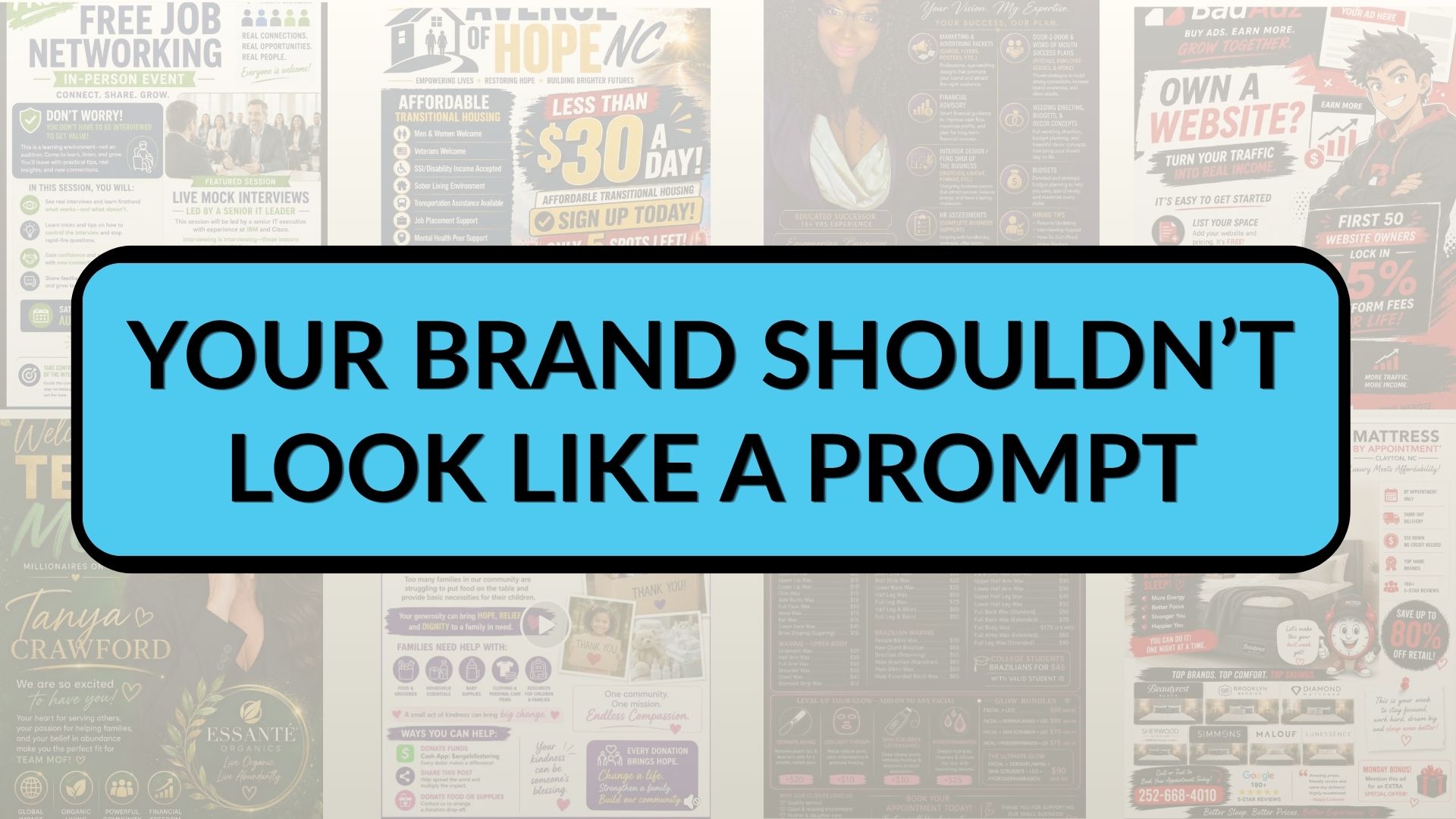
Your Brand Is Not a Prompt | Authentic AI Marketing for Small Business
Artificial intelligence has given small businesses access to marketing capabilities that would have required considerably more time, money and staff only a few years ago.
A business owner can now brainstorm campaigns, organize ideas, develop first drafts, repurpose content, research customer questions and create visual concepts using tools that are readily available and relatively inexpensive.
That is a significant advantage, especially for a small business competing against companies with larger marketing departments and budgets.
The problem is not that businesses are using AI. The problem begins when AI stops functioning as a tool and starts becoming the voice, personality and visual identity of the business.
We are already seeing the result across social media, websites, blogs and email marketing. Different companies are beginning to use remarkably similar language, similar graphics and similar content structures. The business may technically be producing more marketing than ever, but the content becomes less distinctive in the process.
For small businesses, that is an important tradeoff to consider. Your ability to sound human, demonstrate real expertise, show actual work and build personal trust has traditionally been one of your greatest advantages over a much larger competitor.
AI should strengthen that advantage, not erase it.
Can AI Hurt Your Brand?
Yes. AI can hurt a brand when it produces generic messaging, creates unrealistic or misleading visuals, replaces genuine expertise with surface-level content, or makes a business less recognizable to its audience.
That does not mean AI-generated or AI-assisted marketing is inherently harmful. It means the quality of the result still depends on the judgment of the person using the tool. When AI is given strong direction, real business context and appropriate human oversight, it can make marketing dramatically more efficient. When it is expected to make strategic and creative decisions on its own, the result can quickly become generic.
The most effective approach is not to ask whether your business should use AI. A better question is: Where can AI make our marketing more effective without replacing the things our customers value about us?
Why Authenticity Matters More as AI Content Increases
Consumers are becoming increasingly aware that the content they encounter may have been created or altered with AI, and that awareness is beginning to affect trust.
Gartner reported in June 2026 that 49% of U.S. consumers surveyed believed generative AI had made the quality of available content worse. Among Gen Z and Millennial respondents, that figure increased to 57%.
A separate Gartner study found that 50% of U.S. consumers said they would prefer to give their business to brands that did not use generative AI in consumer-facing messaging, advertising and content. The same research found that 68% frequently wondered whether the content and information they encountered was real.
Those findings do not suggest that businesses need to stop using AI. They suggest that **AI has become a trust consideration as well as a productivity tool**.
There is an important distinction between using AI behind the scenes to make your business more efficient and allowing AI to become the primary thing customers experience.
A customer generally does not care whether AI helped you organize ideas for an article, analyze information or turn a rough outline into a better first draft. They may care considerably more if your photographs do not represent your actual work, your content no longer sounds like anyone at your company, or an automated system prevents them from reaching a person when they need help.
The technology itself is not the issue. The customer experience is.
How AI Can Make a Strong Brand Look Generic
Brand recognition is built through consistency, but consistency should not be confused with sameness.
One of the most noticeable problems with AI-generated marketing is the emergence of a recognizable AI aesthetic. We have all seen versions of it: the impossibly polished professional sitting in a spotless office, dramatic lighting, glowing screens, floating icons and a visual style that could represent an accounting firm, marketing consultant, insurance agency or technology company equally well.
The individual graphic may look professional. The problem appears when there is nothing about it that is uniquely connected to the business using it.
The same thing happens with written content. AI can produce technically correct, polished marketing copy very quickly, but without enough direction it frequently falls back on safe, generalized language. Businesses begin “elevating experiences,” “unlocking potential” and “navigating ever-changing landscapes” instead of saying something specific enough to be remembered.
Before publishing AI-assisted marketing, remove the company name and logo and look at the content again. If virtually any competitor could publish the same message or use the same image without changing anything meaningful, AI may have improved the production process without improving the marketing.
More Content Is Not Automatically Better Marketing
One of AI’s greatest strengths is speed. It is also one of the easiest ways for businesses to misuse it.
A small business can now generate a month’s worth of social media ideas, several blog outlines and an email campaign in a fraction of the time those tasks once required. That is valuable when the business already understands what it wants to communicate.
It is considerably less valuable when content volume becomes the goal.
Before AI became widely accessible, creating marketing required enough time and effort that businesses were forced to make choices. Which topics were worth discussing? Which customer questions deserved an article? What did we have to say that would actually be useful?
AI removes much of that friction, but it should not remove the decision-making that went with it.
Publishing thirty pieces of average content does not necessarily create more value than publishing ten useful ones. In fact, increasing content volume without maintaining quality can make it more difficult for customers to understand what your business actually stands for.
AI should make worthwhile content easier to produce. It should not create the obligation to publish simply because creating something has become easy.
When AI Images Can Damage Customer Trust
AI-generated images are not automatically bad for marketing. They can be extremely useful for conceptual illustrations, supporting graphics, abstract visuals, campaign themes and subjects that would otherwise be difficult or expensive to photograph.
The risk increases when an AI image appears to represent something real that the customer is using to evaluate the business.
Consider a remodeling contractor. A potential customer looking through the company’s project gallery reasonably assumes they are seeing projects the contractor completed. Replacing that proof with an AI-generated dream kitchen may create a beautiful website, but it removes one of the most important reasons the customer visited the gallery in the first place.
The same principle applies across many industries. A restaurant should be careful about using artificial imagery to represent an actual menu item. A beauty professional should use genuine work when demonstrating results. A real estate professional should accurately represent a property. An artist or maker should showcase original work. A product-based business should make it clear what the customer is actually purchasing.
This is not really an AI rule. It is a truth-in-marketing rule.
Whenever a customer needs to see the real product, project, person, result or environment in order to make an informed decision, authenticity should take priority over visual perfection.
Real Photography Has Become More Valuable, Not Less
There is an interesting shift happening as AI-generated visuals become easier to create. For years, small businesses often worried that their photographs were not polished enough. They compared themselves with national brands using professional studios, large creative teams and substantial advertising budgets. Now almost anyone can create an idealized visual. That means real photography can carry a different kind of value.
The photograph taken at the actual job site, the quick video from inside the business, the team standing together, the finished project, the owner answering a question or the behind-the-scenes look at how something is made all provide information that synthetic imagery cannot replace.They provide evidence.
For a small business, that evidence is part of the brand. It helps potential customers understand who they are dealing with, what the company actually does and what they can reasonably expect. A real photo does not need to be a bad photo. Good lighting, thoughtful composition and basic editing still matter. But businesses should not mistake artificial perfection for stronger marketing.
Sometimes believable is more persuasive than perfect.
How Should Small Businesses Use AI in Marketing?
Small businesses can use AI very effectively when it supports human expertise rather than attempting to manufacture it. AI is particularly useful during the working stages of marketing. It can help organize ideas, identify patterns in customer questions, develop outlines, compare messaging approaches, repurpose existing material, summarize research and turn rough notes into a stronger starting point. The important part is what goes into the system before generation begins.
Compare these two approaches.
A business owner could ask an AI tool to “write ten social media posts for a roofing company.” The tool will probably produce ten usable posts, but they are likely to resemble content it could create for thousands of other roofing companies.
Now imagine giving the same tool five actual questions homeowners asked this month, three misconceptions the roofing company frequently encounters, two examples from recent projects and the owner’s opinion about a common industry practice.
The resulting content has something the first version does not: source material that belongs to the business
That is one of the simplest ways to use AI without allowing it to flatten your brand. Start with something real and allow AI to help you develop it.
The REAL Test: Should You Use AI for This?
I use a simple framework for evaluating AI-assisted marketing: the REAL Test
Representation: Is the content supposed to represent something that actually exists? If an image or statement represents your work, product, staff, results, location or customer experience, accuracy needs to come before convenience.
Expectation: Could the content create an expectation your business cannot realistically deliver? Marketing should make the offer appealing without creating a fictional version of the product or experience.
Authenticity: Does the finished content still sound and look like your business? If the same message or image could belong to fifty competitors, more of your own perspective needs to be added.
Level of Quality: Does the content meet the standards you would apply if AI had not been involved? Check the writing, visual quality, facts, typography, image details, mobile presentation and overall fit with the brand before publishing.
The last question is particularly important. Businesses should not lower their quality standards simply because a machine produced something quickly.
AI can create a first draft in seconds. The customer still sees the final draft.
Is AI-Generated Content Bad for SEO?
AI-generated content is not automatically bad for SEO. Google states that generative AI can be useful for research and for adding structure to original content. The concern is not simply whether AI was involved; the concern is whether a site is mass-producing low-value material without adding meaningful value for users.Google’s broader guidance continues to emphasize helpful, reliable, people-first content that demonstrates knowledge and firsthand expertise. It specifically recommends creating material that leaves a visitor feeling they have learned enough to accomplish what brought them to the page.That is an important distinction for small businesses. Using AI to help turn twenty years of experience into a clear, useful article can be a productive use of the technology. Asking AI to produce fifty generic articles simply because certain keywords receive search traffic is a very different strategy.
The question for SEO is not simply, “Did AI help create this?”
The better question is, “Does this page contain enough original knowledge, usefulness and expertise to deserve being found?”
What About GEO and AI Search?
The same basic principle applies to generative search. Google’s current guidance for its generative AI search features says that traditional SEO fundamentals remain important and emphasizes unique, expert-led, non-commodity content. Google specifically recommends providing a distinct point of view and firsthand experience rather than simply repackaging information that already exists elsewhere. That is good news for small businesses with genuine expertise. You do not need to make an article sound robotic so an AI system can understand it. In fact, stripping away your expertise and personality in the name of optimization can remove exactly the material that makes the page worth referencing.
A strong article should clearly identify its topic, answer important customer questions directly, use descriptive headings, include meaningful examples, demonstrate firsthand knowledge and make it easy to understand who created the content and why that person is qualified to discuss it.
Those are good SEO practices, good GEO practices and, more importantly, good communication.
How Do You Optimize Content for Voice Search?
Voice searches tend to resemble natural questions. Someone is more likely to ask, “Should my business use AI-generated images?” or “Are AI images bad for SEO?” than to speak a string of disconnected keywords.
The best response is not to fill a page with awkward question phrases. Instead, identify the genuine questions customers ask and answer them clearly within useful, comprehensive content.
For example:
Should a small business use AI-generated images? Yes, when the images support an idea or creative concept and are not being used to misrepresent real products, people, projects or results.
Can AI make a business look less authentic? It can if the content becomes generic, artificial or disconnected from the company’s real voice and customer experience. The risk comes from how AI is used, not simply from using AI.
Should AI write all of a company’s marketing content? AI can help create drafts and accelerate production, but final messaging should still reflect the company’s expertise, opinions, examples and brand standards.
These concise answers help people find information quickly while the surrounding article provides the depth and context needed to make the answer useful.
A Better AI Marketing Workflow for Small Businesses
The strongest approach is neither “AI everything” nor “AI nothing.” It is a human-led process in which AI handles appropriate parts of the workload.
1. Begin with a real business objective or customer question. Decide what the content needs to accomplish before opening an AI tool.
2. Provide original source material. Add your experiences, opinions, examples, customer questions, brand information and relevant facts.
3. Use AI to assist with development. Let it organize, expand, compare, edit or repurpose rather than expecting it to invent the entire strategy.
4. Apply human judgment before publishing. Check accuracy, tone, relevance, visual quality, customer expectations and whether the content still feels consistent with the brand.
5. Measure the result. If AI helps you produce more but the content generates less engagement, trust, traffic or business, faster production has not solved the real problem.
This process still delivers the time and cost advantages that make AI so appealing to small businesses. What it does not do is hand over the brand.
The Opportunity for Small Businesses
One reason I remain enthusiastic about AI is that it can genuinely help level the playing field. Small companies have historically competed against larger organizations with bigger advertising budgets, dedicated content teams, professional researchers, copywriters and designers. AI gives an owner or small internal team access to capabilities that can make many of those tasks faster and more manageable.
That matters.
But small businesses should be careful not to give up their natural advantage while trying to acquire the capabilities of larger companies. A large corporation may be able to produce an enormous amount of polished marketing. A small business often has much easier access to the owner, the people doing the work, direct customer conversations, specific expertise and genuine local relationships. Those things are extremely valuable marketing material.
Use AI to help capture them, organize them and communicate them more efficiently. Do not use it to replace them.
Your Brand Is Not a Prompt
AI will continue to become more capable. Businesses will be able to generate more content, create better visuals, automate more interactions and complete marketing tasks faster than they can today. That makes human judgment more important, not less. A strong brand is built from experience, reputation, customer understanding, personality, values, opinions, real work and thousands of decisions made over time. It cannot be reduced to a prompt asking a machine to “make this engaging and professional.”
Use AI to save time. Use it to reduce costs. Use it to develop ideas, overcome bottlenecks and give your small business access to capabilities that once required a much larger budget. But keep someone who understands the business in charge of the final result.
Because AI should make it easier to communicate what makes your business different. It should never erase the difference.
Want to Use AI Without Losing What Makes Your Brand Yours?
I’ve created a free AI Authenticity Guide specifically for small business owners who want the benefits of AI without ending up with generic messaging or a brand that no longer sounds like them. The guide covers 5 things not to do and 5 things to do when using AI in your marketing, with practical guidance you can apply immediately.